
Walters and McCall now Tied for Second, but still 35-points Behind Drummond

Sooner Survey: Volume 36 No. 4 | August 25, 2025
By Pat McFerron, President
Cole Hargrave Snodgrass & Associate
 @McFerron
Recent news exposure has not been helpful for a potential gubernatorial run for Ryan Walters. Not only has his percentage in a Republican primary fallen, but his favorable to unfavorable ratio within his own party is as poor as any we have recorded during our more than 30 years of surveying Oklahomans.
Among likely Republican primary voters, Walters now sits at 31% favorable and 44% unfavorable – a net change of 13 points since the 37%-37% we recorded in early May. Perhaps more striking is that 34% of likely Republican primary voters say their impression of him is “strongly unfavorable” and only 15% characterize their opinion as “strongly favorable. Rural voters have moved dramatically and are now a net negative (29% Favorable / 37% Unfavorable). While Walters still has positive numbers among the 44% who adopt a “Trump Republican” label (43% Favorable / 28% Unfavorable), among the 45% who claim the title of “Traditional Republican”, his numbers have severely tanked (22% Favorable / 61% Unfavorable).
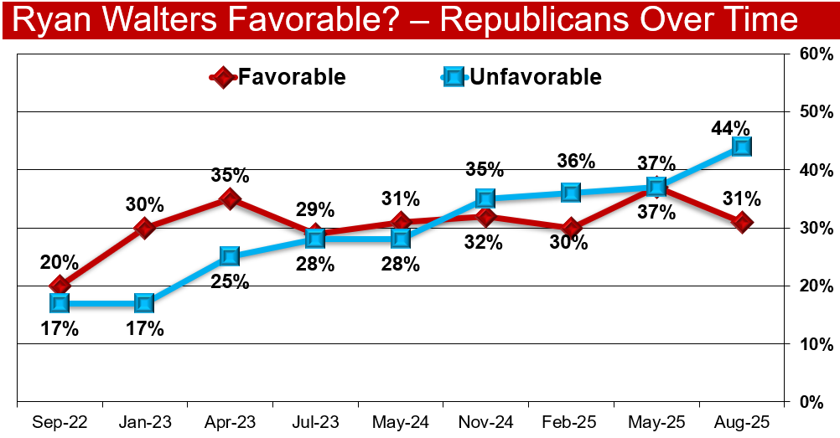
His personal ratings are having an effect on his electability. In an early May 2025 study (https://chs-inc.com/2026-drummond-walters/) Walters was at 14% in a ballot test including the same candidates we tested earlier this month. He now sits at only 8%, losing almost half of his support. That being said, Walters does still do best among the most prolific primary voters. Among those who have voted in at least four of the last five primary elections, he remains a net positive (39% Favorable / 37% Unfavorable) and he does very well among the 32% who watch Fox News on a regular basis (48% Favorable vs. 24% Unfavorable).
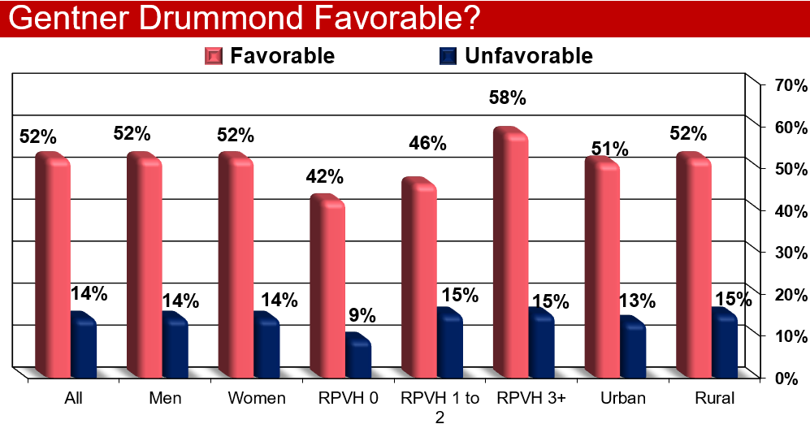
While discussion of Walters gets more eyeballs to stories, any discussion about Oklahoma’s GOP primary for governor has to start with Gentner Drummond. Drummond’s ratio among Republicans primary voters now stands at almost a 4-to-1 positive ratio (52% Favorable vs. 14% Unfavorable). Since May, his negative has gone down three points and he has improved his showing among the more conservative elements of the Republican electorate, including those who have voted in at least three of the last five GOP primaries (58% Favorable vs. 15% Unfavorable). In addition, there is still room for Drummond to grow as more than a third of likely primary voters have not yet formed an opinion of him (24% Heard Name / No Opinion; 11% Do Not Recall Name).
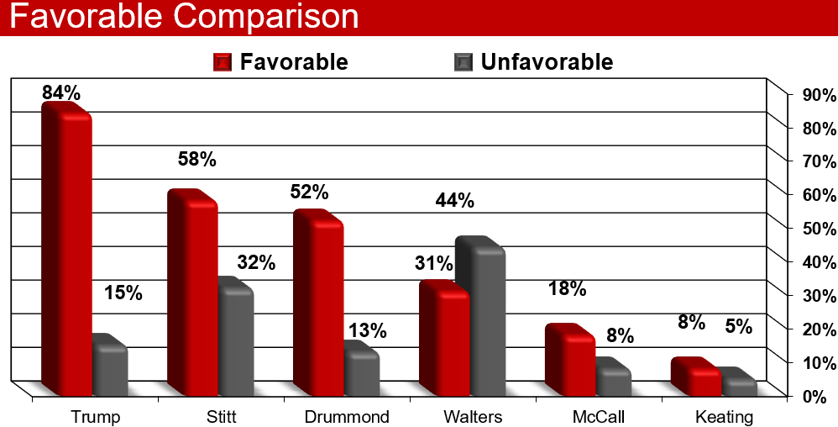
Charles McCall does demonstrate some movement, but at 18% favorable vs. 8% unfavorable among likely GOP primary voters, he not only trails Drummond in absolute name ID, but in ratio as well. In fact, despite 66% rating Drummond and only 26% rating McCall, McCall’s strongly unfavorable (5%) is almost the same as Drummond’s (6%). Still, the McCall team should be pleased that in three months McCall has increased his favorable rating from 12% to 18% and done so without expending resources on substantial advertising.
Chip Keating’s favorable ratings have not changed since we first looked at the former State Trooper and son of Republican icon Frank Keating. While there is little doubt his name identification could expand quickly, right now, only 13% hold an impression of Keating, and the favorable to unfavorable ratio is less than two-to-one (8% Favorable / 5% Unfavorable). He does do better in the family’s historic home of Tulsa (10% Favorable / 1% Unfavorable).
Given the favorable ratings, it is no wonder that Gentner Drummond has a commanding lead, with or without Ryan Walters in the race.
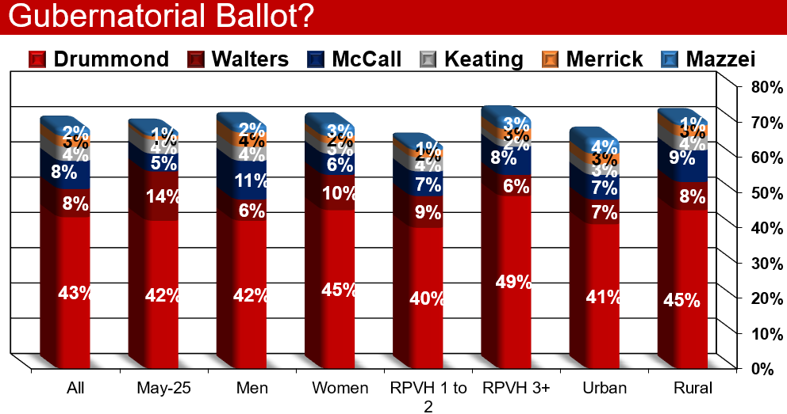
In February, Drummond held a 30-point lead over Walters and 39-points over McCall. In May, the lead over Walters was 28 points and 37 over McCall. Today, the lead over Walters has increased to 35 points, the same as it is over McCall.
Drummond currently sits at 43% support in a contest including Ryan Walters with Walters and McCall both tied at 8%. None of the other tested candidates (Chip Keating, Jake Merrick, and Mike Mazzei) exceed 4%. A third (33%) remain undecided.
Drummond’s lead is strong everywhere, but particularly among those who have voted in at least three primaries. There his number escalates to 49% while no other candidate exceeds 8% (McCall). Drummond does particularly well in the Tulsa media market (51%; Walters 8%; McCall 4%) and among those watching Fox News at least an hour per day (47% Drummond; 8% McCall). Additionally, McCall does well among the more affluent elements of the primary electorate. Among the 19% with household incomes exceeding $150,000, Drummond is at 50%, McCall at 9%, and Walters drops to 4%.
With Walters out, Drummond is even stronger, sitting at 48% of those surveyed and a remarkable 72% of decided voters. Drummond actually gets support from 43% of those who were supporting Walters while McCall garners 17% of those voters, getting his total to 10-points, still trailing Drummond by 38. No other candidate sees much benefit at all from Walters not running.
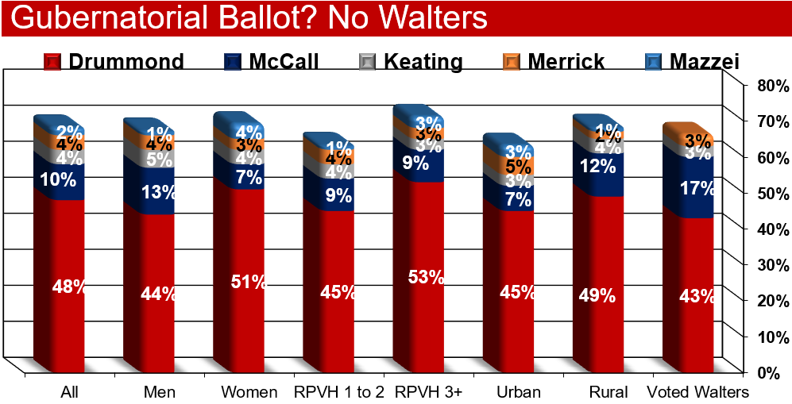
This contest is still early. But Drummond does seem poised to run away with the nomination. Drummond is NOT like an incumbent where those undecided voters might be looking for the alternative – in this case, they still do not know Drummond.
The best historic example we have for an open-seat gubernatorial contest is 2018. At this time in that cycle, Kevin Stitt was an unknown – but no candidate was anywhere near as strong as Drummond is today. For all candidates other than Drummond, this contest is no longer about building a coalition, but it will also require taking apart Drummond’s existing base – a very tall order.
Drummond has developed strength among the more conservative and reliably voting elements. Anyone looking to challenge him will need to start soon and distinguish themselves from the cadre of candidates. Right now, it is a race for a spot in a runoff – but a runoff is not guaranteed. ◊


Recent Comments