

Sooner Survey: Volume 37 No. 10 | August 13, 2026
By Pat McFerron, President
Cole Hargrave Snodgrass & Associate
 @McFerron
With the Republican runoff for Governor so competitive and so contentious, it is little wonder that down ballot contests are not receiving more attention. In fact, all three of the statewide runoffs for secondary offices are currently within the margin of error and have at least 44% of voters still undecided.
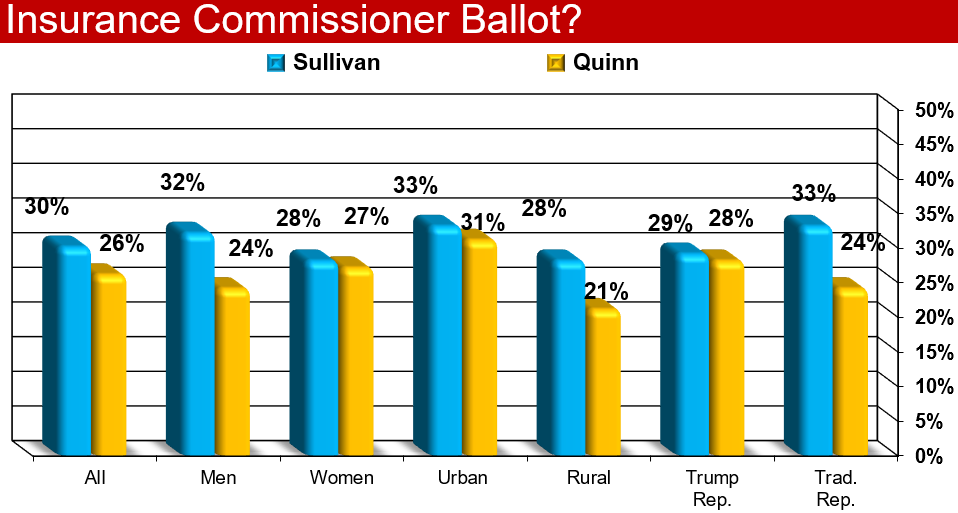
Bob Sullivan’s four-point lead over Marty Quinn in the Insurance Commissioner contest is the widest of the three – and that is still very close, especially when considering 44% are undecided. Blocs most likely to support Sullivan are men (32% Sullivan / 24% Quinn), those who have voted in 4 or more of the last 5 primaries (35% Sullivan / 23% Quinn) and those in the Oklahoma City media market (34% Sullivan / 26% Quinn) and among Traditional Republicans (33% Sullivan / 24% Quinn). In contrast, Quinn has slight advantages among self-described “very conservative” voters (26% Sullivan / 27% Quinn) and is more competitive among women (28% Sullivan / 27% Quinn) and within the Tulsa media market (28% Sullivan / 28% Quinn) and Trump Republicans (29% Sullivan / 28% Quinn).
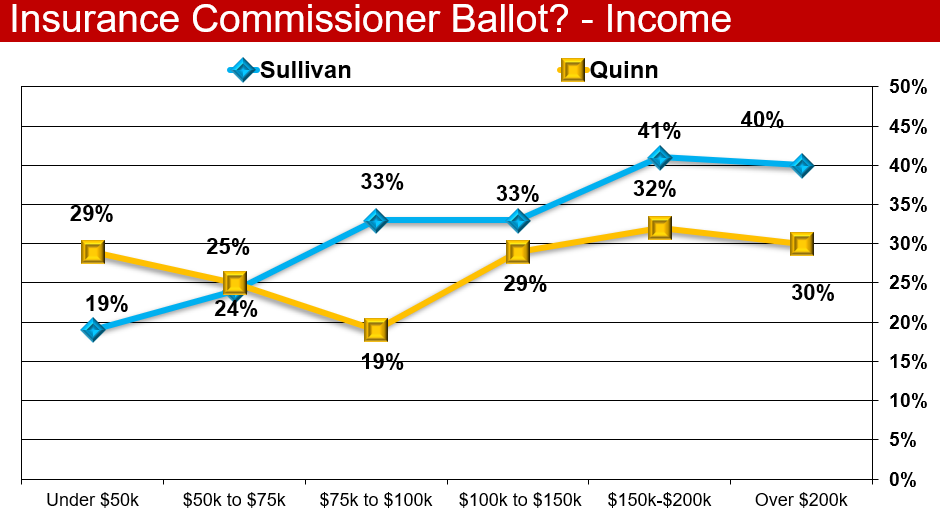
There are two additional points that jump out of the data. First is Sullivan’s lead among what I consider a critical swing bloc within Republican electorates, the 32% of voters with a favorable impression of Donald Trump but who prefer the label “Traditional Republican” not “Trump Republican.” Here, Sullivan’s lead balloons to 14-points (35% Sullivan / 21% Quinn). This could be an indication that Sullivan has a base in the middle and it could be difficult for Quinn to put together those on both sides of that spectrum. The other factor that emerges is how much more decided this contest becomes with income. For voters in the 20% of households with incomes below $50,000 a year, 52% are undecided in this contest. Among the 23% with annual incomes over $150,000, only 12% are undecided. The income lines are pretty strong, with Quinn leading among those with incomes of less than $50,000, being essentially tied in the $50,000 to $75,000 range and then Sullivan having an advantage among all higher income groups.
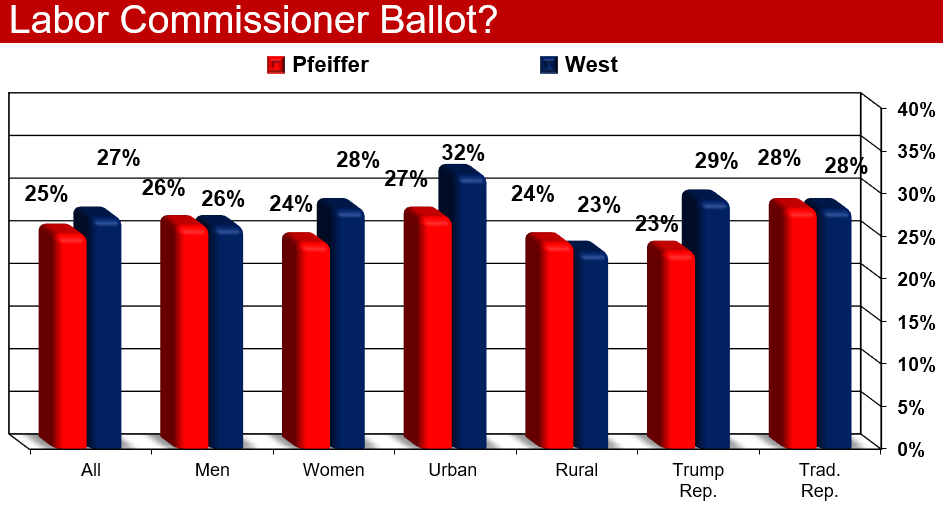
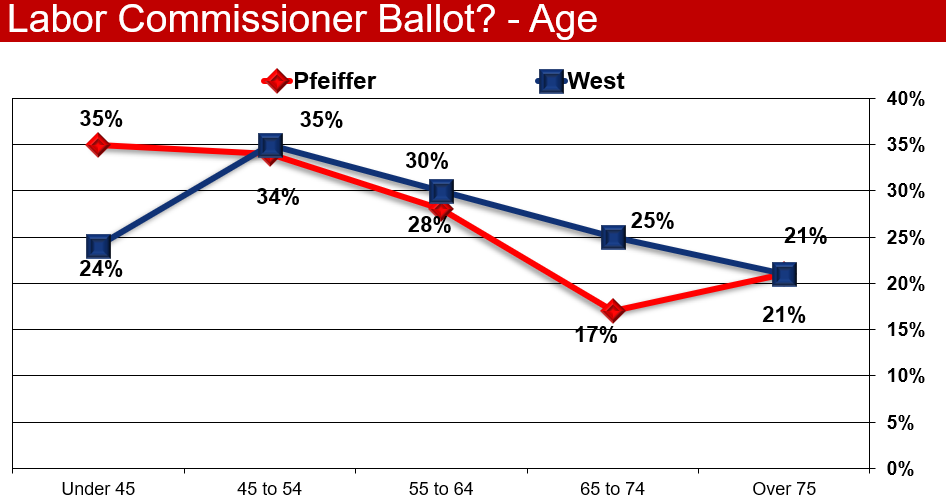
In the Labor Commissioner race we have the highest number of undecided voters (48%), where Kevin West starts with a two-point lead in his battle with legislative colleague John Pfeiffer. This contest has very little definition with the most significant being geographic. Pfeiffer leads in the rural northwest (34% Pfeiffer / 30% West) and southwest (32% Pfeiffer / 14% West) but that is offset by West’s support in central Oklahoma (23% Pfeiffer / 36% West). Currently, West has a six-point advantage among Trump Republicans (23% Pfeiffer, 29% West) while Traditional Republicans are evenly divided (28% Pfeiffer / 28% West). The key to this contest is likely who can capture the hearts and minds of voters 65 years of age or older. This group represents 44% of the electorate and 58% of them are currently undecided as 19% support Pfeiffer and 23% are committed to West.
While the political class probably spends more time focused on the race for State Superintendent, voters do not seem to be paying attention there yet. Given the furor created during the reign of Ryan Walters, this seems a little strange, but the numbers prove it. Not only are 47% of voters undecided, but the alignment with ideology is not as strong as most close observers would think. That being said, there is still more definition here than in the other two contests discussed in this newsletter.
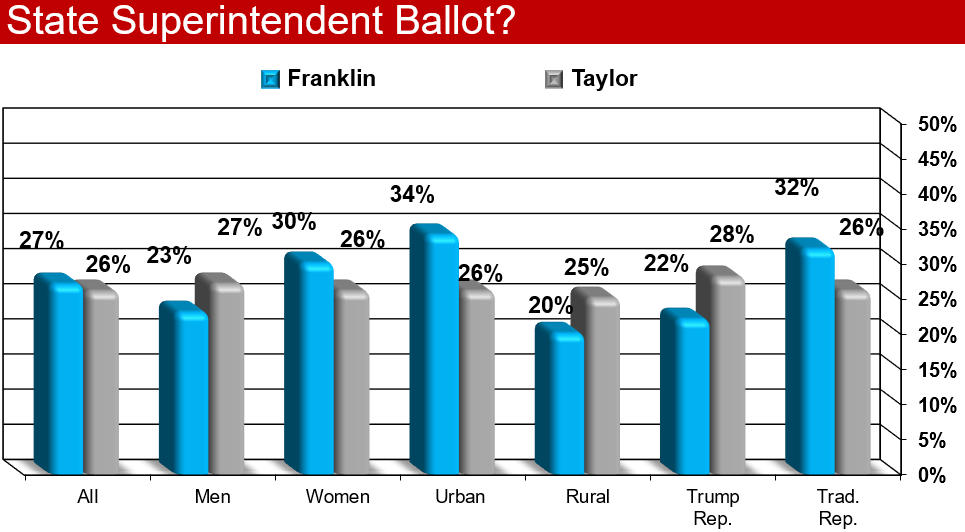
In this one-point contest (Franklin 27% / Taylor 26%), Taylor is putting together a more conservative coalition. He leads by 8-points among those labeling themselves “Very Conservative”, but only by one-point among “Somewhat Conservative” voters. The 21% who say they are moderate Republicans break strongly for Franklin (43% Franklin / 24% Taylor). Trump Republicans break toward Taylor (22% Franklin / 28% Taylor) while Traditional Republicans (a larger group) give Franklin a six-point advantage (32% Franklin / 26% Taylor). Again, we see the decisive group of voters over the age of 65 being the most undecided. Here, a remarkable 61% are not yet committed – total, that represents almost 27% of all voters.
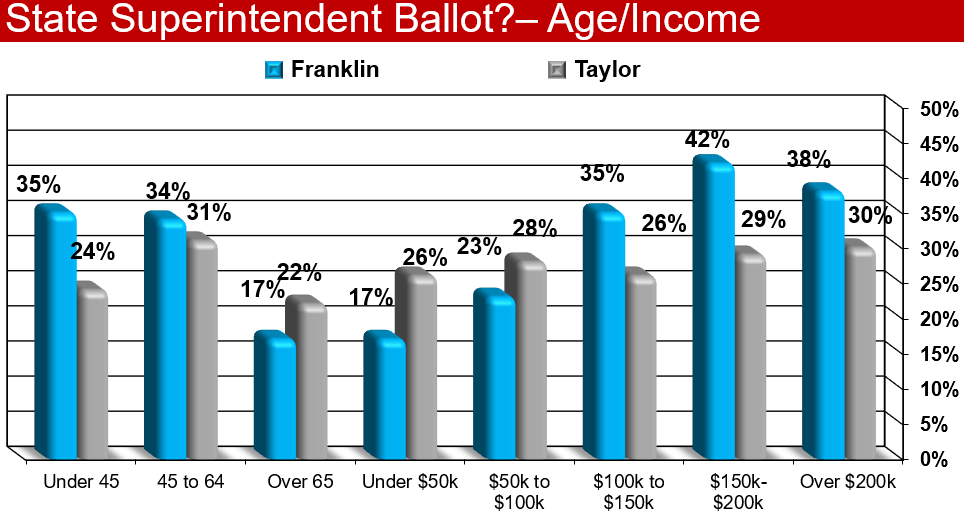
We do see more definition along income lines. In households with incomes less than $50,000 a year, Taylor has a nine-point lead, while Franklin leads by 10 among those with annual incomes exceeding $100,000. Even more granular, Taylor leads by a few points among those with incomes between $50,000 and $75,000 while Franklin leads among those with between $75,000 and $100,000.
All of these races are too close to call at this point. It really will get down to who turns out to vote. Many prognosticators believe that 160,000 total votes will win most of these contests – and that is only 4% of the state’s 4 million residents. Money, as always, will be a critical factor in the final weeks, but if it is difficult for candidates to cut through the noise of the gubernatorial contest, organization and grassroots could be vital, especially as close as all of these contests are. ◊



Recent Comments